 |
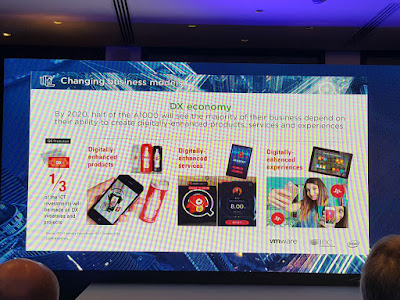
| By end 2020 half of A1000 organisations (top Asian organisations) will see the majority of their business depend on their ability to create digitally enhanced products, services, and experiences. IDC predicts that one-third of ICT investments will be are on DX initiatives, models and projects. The slide shows key digital initiatives; from left: Blippar and Coca-Cola; digital red packets; and Musical.ly. |
IDC is supporting organisations on digital transformation, which the company calls 'DX'. The research firm predicts that by end-2020 half of A1000 organisations (the top 1,000 Asian organisations) will see the majority of their business depend on their ability to create digitally enhanced products, services, and experiences. IDC predicts that one-third of ICT investments will be DX initiatives, models and projects by 2020.
"To win and lead in the DX economy you need to become a digital native enterprise," Sandra Ng, Group Vice President heading IDC's Asia/Pacific Practice Group, said at the VMware CIO Leadership Forum 2017 in Singapore, which was themed Leading your Digital Transformation Journey. "The good news (is that) no one has become one yet."
That said, IDC has identified "very progressive" brick-and-mortar enterprises which are digital native enterprises in the making, Ng added, profiling IKEA and DBS as some of the leaders in the race. DBS launched an all-digital bank in India in early 2016 to compete against established banks, successfully targeting highly mobile consumers, while IKEA launched a virtual reality app in 2013 which allowed consumers to see how a product would fit in their own living rooms, plus an online wedding business in 2015. "This is their way of trying to expand and diversify, to basically up their revenue stream," Ng said.
Ng also observed that the telecommunications industry has stepped up over the last 18 to 24 months. "They have definitely recognised that they have to do something and do something quick in order to compete in the DX economy," she said, naming Etisalat and Vodafone as telcos which are at the forefront of the movement.
Other key initiatives disrupting traditional ways of doing business include:
- Coca Cola's collaboration with Blippar, which turns a picture of a Coke can into a jukebox playing a Spotify list of the top 50 songs of the region. The app has been launched in the UK and North America.
- China's Alibaba and Tencent hold big digital red packet campaigns every Chinese new year. For the past four to five years, consumers in China have been able to gift money in digital red packets to friends, family and even total strangers. This year, both companies upped the ante with add-ons inspired by the Pokemon Go game, enabling digital red packets to be 'left' in physical locations for others.
- Musica.ly, founded in China and now one of the hottest apps for teens in the US, which allow teens to lip-sync videos and share the results on social networks. The app has 130 million users.
That said, IDC has identified "very progressive" brick-and-mortar enterprises which are digital native enterprises in the making, Ng added, profiling IKEA and DBS as some of the leaders in the race. DBS launched an all-digital bank in India in early 2016 to compete against established banks, successfully targeting highly mobile consumers, while IKEA launched a virtual reality app in 2013 which allowed consumers to see how a product would fit in their own living rooms, plus an online wedding business in 2015. "This is their way of trying to expand and diversify, to basically up their revenue stream," Ng said.
Ng also observed that the telecommunications industry has stepped up over the last 18 to 24 months. "They have definitely recognised that they have to do something and do something quick in order to compete in the DX economy," she said, naming Etisalat and Vodafone as telcos which are at the forefront of the movement.
Other key initiatives disrupting traditional ways of doing business include:
- Coca Cola's collaboration with Blippar, which turns a picture of a Coke can into a jukebox playing a Spotify list of the top 50 songs of the region. The app has been launched in the UK and North America.
- China's Alibaba and Tencent hold big digital red packet campaigns every Chinese new year. For the past four to five years, consumers in China have been able to gift money in digital red packets to friends, family and even total strangers. This year, both companies upped the ante with add-ons inspired by the Pokemon Go game, enabling digital red packets to be 'left' in physical locations for others.
- Musica.ly, founded in China and now one of the hottest apps for teens in the US, which allow teens to lip-sync videos and share the results on social networks. The app has 130 million users.
- Macy's entered the China market on an Alibaba platform. Through virtual reality, shoppers can walk through a virtual Macy's store and buy whatever they see. "Welcome to the new world," commented Ng. "As a result of this Macy's has completely changed their go-to-market strategy in China."
IDC has created a digital native enterprise framework to guide enterprises, covering game-changing technologies as well as priorities for leaders such as mastering leaderships, relationships, the use of data to create competitive advantage, operations through automation and agile processes, as well as talent.
Key performance indicators (KPIs) for these areas of mastery are critical, with IDC predicting that:
"If your organisation is currently thinking of putting in an organisational structure you need to be that Strategic CIO on that DX dream team," she said. "If you are already on that dream team, now (it is about) driving IT and charging ahead - you're the most knowledgeable with regards to tech and digital and therefore you should be in a very good position if not the best position to be in the driver's seat with the CEO to become a digital native enterprise."
The five steps to get to be the Strategic CIO include:
1. Getting the house (IT infrastructure) in order
2. Showcasing and demonstrating that you can work well with business units
3. Show that you understand the business and can contribute to business growth. "It is about understanding where your organisation is and the competition is, and that the competition is moving forward in the new space that you will enter," she said.
4. Demonstrate near-term returns in order to obtain more money
5. Demonstrate the roadmap and what the future will look like.
"At IDC we don't believe in bimodal IT," said Ng. "There is only one speed and that is faster."
Digital transformation needs to be end-to-end within an organisation, she added. "No company can scale if they only rely on one department to do digital transformation. It must cut across the enterprise and through the partner ecosystem."
Interested?
Read the TechTrade Asia blog post about Gelsinger's keynote at the CIO Leadership Forum 2017, and the post about Gelsinger's fireside chat with Ng
Check out the TechTrade Asia blog post about DBS' all-mobile bank in India
posted from Bloggeroid
 |
| The five digital masteries towards DX. |
IDC has created a digital native enterprise framework to guide enterprises, covering game-changing technologies as well as priorities for leaders such as mastering leaderships, relationships, the use of data to create competitive advantage, operations through automation and agile processes, as well as talent.
Key performance indicators (KPIs) for these areas of mastery are critical, with IDC predicting that:
- Leadership mastery - 25% of top executives will have technology leadership expertise
- Relationship mastery - 65% of organisations that allow customers to own their experiences will realise significantly better net promoter scores (NPS)
- Information mastery - 45% of top 1,000 companies will generate 2x revenue growth from information-based products versus the rest of their portfolio
 |
| The differences between traditional and digital product development. |
- The CEO - the DX executive sponsor
- The CFO - playing a supportive role, but key to the CEO through providing data and analytics
- The strategic CIO - the IT modernisation enabler and new technology advisor
- The COO - holds the organisational view, with cross functional operations responsibility
- The Chief Digital Officer (CDO) - the lead change agent with digital-first initiatives
- The CTO - the digital product development champion, and the person to bridge the gap between IT and industry technology, and to bring together digitally-enhanced products for the organisation
"If your organisation is currently thinking of putting in an organisational structure you need to be that Strategic CIO on that DX dream team," she said. "If you are already on that dream team, now (it is about) driving IT and charging ahead - you're the most knowledgeable with regards to tech and digital and therefore you should be in a very good position if not the best position to be in the driver's seat with the CEO to become a digital native enterprise."
The five steps to get to be the Strategic CIO include:
1. Getting the house (IT infrastructure) in order
2. Showcasing and demonstrating that you can work well with business units
3. Show that you understand the business and can contribute to business growth. "It is about understanding where your organisation is and the competition is, and that the competition is moving forward in the new space that you will enter," she said.
4. Demonstrate near-term returns in order to obtain more money
5. Demonstrate the roadmap and what the future will look like.
"At IDC we don't believe in bimodal IT," said Ng. "There is only one speed and that is faster."
Digital transformation needs to be end-to-end within an organisation, she added. "No company can scale if they only rely on one department to do digital transformation. It must cut across the enterprise and through the partner ecosystem."
Interested?
Read the TechTrade Asia blog post about Gelsinger's keynote at the CIO Leadership Forum 2017, and the post about Gelsinger's fireside chat with Ng
Check out the TechTrade Asia blog post about DBS' all-mobile bank in India
posted from Bloggeroid
No comments:
Post a Comment